The tree—identified in the City of Winnipeg tree inventory
as Tree ID 172616—is a birch marked with a green dot. Often referred to
as the “kiss of death,” the green dot indicates a tree that is dead, dying, or
otherwise slated for removal. The tree’s recorded location (x: 631482.84, y:
5524351.15) places it within Rooster Town Park, a site renamed in 2022
to acknowledge the Métis road allowance community that once occupied this land
and was displaced through mid-20th-century urban development.
![]()
Today, the area is more commonly known as Grant Park and is defined by civic and commercial uses: Pan Am Pool (constructed for the 1967 Pan American Games), Grant Park Shopping Centre (established in 1964), Grant Park High School (1959), and surrounding suburban housing. Together, these developments reflect a period of urban expansion that erased a vibrant Métis community from the landscape.
Based on its diameter at breast height, species, and typical growth rates, the birch likely did not witness this displacement directly. Best estimates suggest it was planted—or allowed to mature—around the time Grant Park High School was established, making it approximately 65–70 years old. Even so, it stands as a large, aging birch nearing the end of its life. The project asks: how might this tree honour the place it has lived?
The children’s book The Giving Tree is grounded in Métis culture and follows Moushoom as he recalls moments from his childhood, including a journey with his parents to discover the “great giving tree.” Through gentle storytelling and vivid illustration, the book offers a contemporary retelling of a traditional Métis teaching. Central to the story is a worldview rooted in generosity, reciprocity, and respect between human and botanical worlds. From this perspective, the project asks how a tree marked for removal might continue to exist—both materially and symbolically—within Rooster Town Park.
The project borrows its name from this Métis story, in which families placed goods within the hollows of familiar trees—everyday acts of generosity that sustained relationships between people, land, and community. Beginning with the existing birch, the project adopts an ethic of making the most of what the land has offered. Harvesting the tree becomes both a careful act of reuse and a celebration of place.
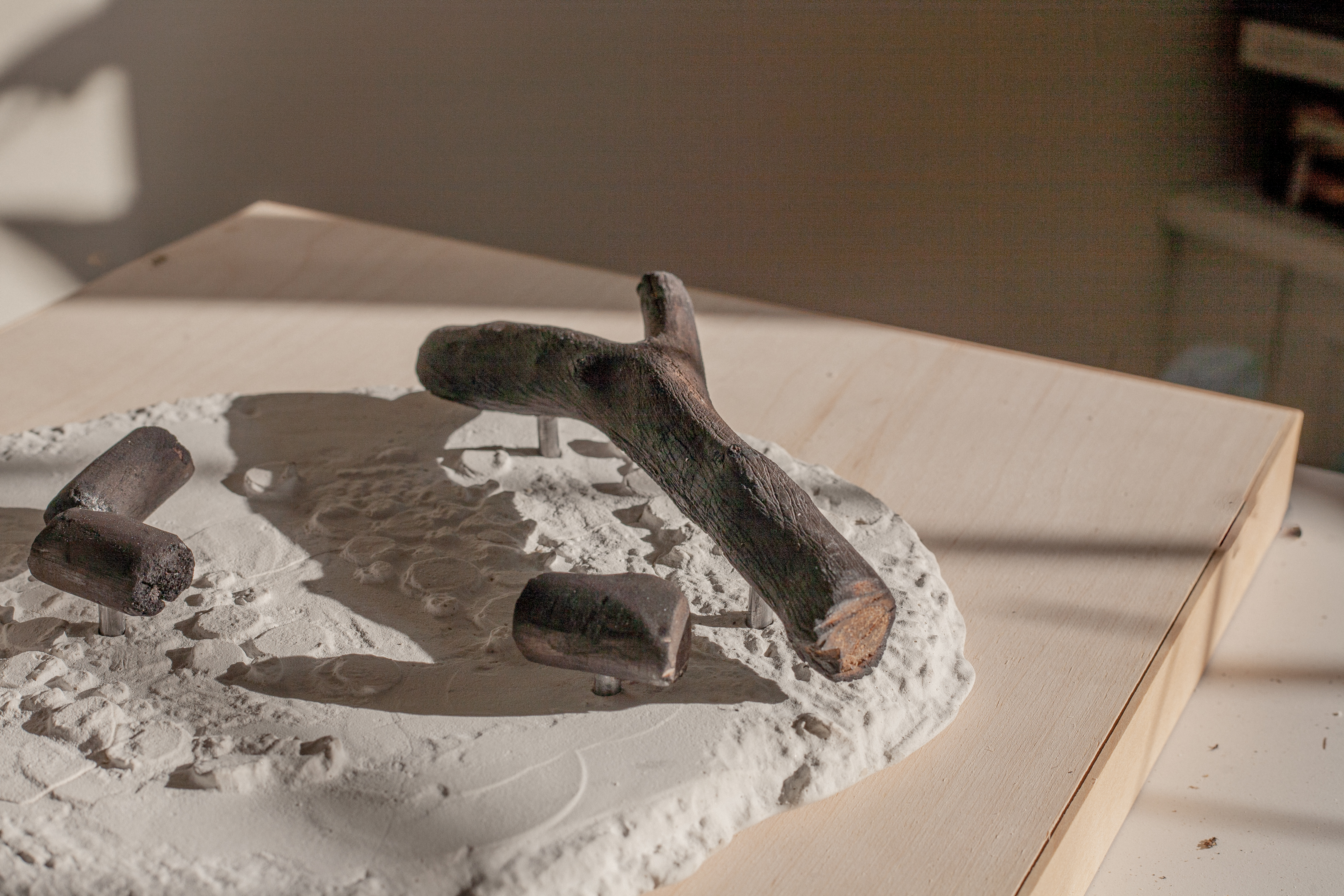
Through observation, 3D scanning, and handcraft, the birch is transformed into a new gathering space at the heart of the Indigenous Language Nodes. A high-resolution scan records the tree’s form, allowing its natural geometry to guide the design process. From this digital memory, the “bench” emerges in four related gestures: a long log bench, a series of chunk chairs, a stump with an offering bowl and a connective wood surface that traces the former reach of the tree’s canopy across the ground. This horizontal translation of the tree creates places to sit together, learn together, and hold ceremony.
Following harvest, the wood is carefully prepared—debarked, dried, sawn, charred, brushed, and oiled—transforming the pale birch into a deep, carbonized surface that both protects the material and reveals its grain. The remaining stump is left and capped with a stainless steel offering bowl and plate, allowing the tree to continue receiving and holding stories, gestures, and gifts.
Rooted in the life of a single tree and guided by the teachings of reciprocity, The Giving Tree expresses a cycle of growth, loss, and renewal. It offers a quiet space in the landscape—an invitation to gather, remember, and continue the relationship between land, language, and community.

The Giving Tree -
Tree ID 172616
Today, the area is more commonly known as Grant Park and is defined by civic and commercial uses: Pan Am Pool (constructed for the 1967 Pan American Games), Grant Park Shopping Centre (established in 1964), Grant Park High School (1959), and surrounding suburban housing. Together, these developments reflect a period of urban expansion that erased a vibrant Métis community from the landscape.
Based on its diameter at breast height, species, and typical growth rates, the birch likely did not witness this displacement directly. Best estimates suggest it was planted—or allowed to mature—around the time Grant Park High School was established, making it approximately 65–70 years old. Even so, it stands as a large, aging birch nearing the end of its life. The project asks: how might this tree honour the place it has lived?
The children’s book The Giving Tree is grounded in Métis culture and follows Moushoom as he recalls moments from his childhood, including a journey with his parents to discover the “great giving tree.” Through gentle storytelling and vivid illustration, the book offers a contemporary retelling of a traditional Métis teaching. Central to the story is a worldview rooted in generosity, reciprocity, and respect between human and botanical worlds. From this perspective, the project asks how a tree marked for removal might continue to exist—both materially and symbolically—within Rooster Town Park.
The project borrows its name from this Métis story, in which families placed goods within the hollows of familiar trees—everyday acts of generosity that sustained relationships between people, land, and community. Beginning with the existing birch, the project adopts an ethic of making the most of what the land has offered. Harvesting the tree becomes both a careful act of reuse and a celebration of place.
Through observation, 3D scanning, and handcraft, the birch is transformed into a new gathering space at the heart of the Indigenous Language Nodes. A high-resolution scan records the tree’s form, allowing its natural geometry to guide the design process. From this digital memory, the “bench” emerges in four related gestures: a long log bench, a series of chunk chairs, a stump with an offering bowl and a connective wood surface that traces the former reach of the tree’s canopy across the ground. This horizontal translation of the tree creates places to sit together, learn together, and hold ceremony.
Following harvest, the wood is carefully prepared—debarked, dried, sawn, charred, brushed, and oiled—transforming the pale birch into a deep, carbonized surface that both protects the material and reveals its grain. The remaining stump is left and capped with a stainless steel offering bowl and plate, allowing the tree to continue receiving and holding stories, gestures, and gifts.
Rooted in the life of a single tree and guided by the teachings of reciprocity, The Giving Tree expresses a cycle of growth, loss, and renewal. It offers a quiet space in the landscape—an invitation to gather, remember, and continue the relationship between land, language, and community.